Home>RESEARCH>Research Progress

Institute of Vertebrate Paleontology and Paleoanthropology
Chinese Academy of Sciences
Chinese Academy of Sciences

Home>RESEARCH>Research Progress
In 2010, a previously unknown hominin lineage, Denisovans, was reported based on ancient DNA extracted from a phalanx recovered from Denisova Cave in Siberia. Since then, growing fossil and molecular evidence have continued to reveal that Denisovans were probably widely distributed across Northeast Asia, the Tibet Plateau, Southwest and Southeast China, as well as Laos in Southeast Asia, spanning approximately 300 ka to 45 ka. However, although molecular evidence has continued to expand their distribution, the typical Denisovan morphology has not yet systematically summarized. By comparison, their close relatives, Neanderthals and modern humans, have a set of diagnostic characteristics. To characterize Denisovan morphologically, an ideal site with abundant hominin fossils, a clear stratigraphic context, and reliable chronological age, is required.
The Harbin cranium, assigned to Denisovan by molecular evidence, providing an important reference for summarizing morphological commonalities. The Xujiayao hominins, discovered in northern China, dated to the late Middle Pleistocene (199 ka-138 ka), was classified as Homo juluensis, a species that also includes the Siberian Denisovans. Other evidence also implies that the Xujiayao hominins may be Denisovans. During the 1976-1979 excavations at Xujiayao site, a total of 20 hominin fossils was found, including crania, mandibles, and teeth, representing at least 16 individuals. These remains make Xujiayao one of most diverse hominin fossil assemblage with the clearest stratigraphy among late Middle Pleistocene archaic Homo sites in East Asia. If its Denisovan identity is confirmed, the Xujiayao hominin will not only resolve its own taxonomic assignment, but will also become a key specimen for characterizing Denisovan morphological commonalities.
To clarify this issue, the team of Qiaomei Fu from the Institute of Vertebrate Paleontology and Paleoanthropology (IVPP), Chinese Academy of Sciences, together with Nanjing Normal University and Peking University, conducted proteomic and morphological analyses of Xujiayao fossils. The proteomic evidence obtained from the parietal bone and mandible of Xujiayao hominins clearly supports its assignment to Denisovans. On this basis, the research team systematically summarized the typical features of Denisovans in the cranium, mandible, and teeth. Additionally, they also compare the Xujiayao with confirmed Denisovans (Harbin, Xiahe, and Penghu), as well as other East Asian late Middle Pleistocene archaic Homo without certain taxonomic assignment (Jinniushan, Dali, Hualongdong, Longyadong, Tongzi, and Panxian Dadong). The results suggest that most members of late Middle Pleistocene archaic Homo in East Asia may all belong to Denisovans. This study extends the distribution of Denisovans to nearly the entire East Asian mainland, suggesting that their ecological adaptability may have exceeded that of Neanderthals, encompassing plateau, subtropical rainforest, and island environments. The study was published in Nature on October 21th, 2026.
To clarify the taxonomy of the Xujiayao hominin, the research team successfully extracted endogenous proteins from one of the parietal bones (PA1490) of Xujiayao individual 6 and the mandible (PA1497) of individual 14, and found that both samples carry the Denisovan-specific variant COL1A2-996K, whereas Neanderthals and modern humans exhibit the ancestral variant COL1A2-996R. The study also reconstructed a Bayesian phylogenetic tree using a concatenated sequence of 2,074 amino acid sites from 8 endogenous proteins. The Xujiayao hominin, Denisova 3, and other Denisovan-related individuals consistently form a monophyletic group with very high posterior probability (>99%). Taken together, these lines of evidence support that the two Xujiayao samples belong to Denisovans.
The Xujiayao hominins, confirmed by proteomics as Denisovans, together with the Harbin individual, provides a key reference for Denisovan morphology. The research team summarized a suite of typical Denisovan morphological features and found that they retain some erectus-like features (e.g., a low and broad braincase and relatively thick cranial vault) whole showing derived states in other traits (e.g., a highly arched superior margin of the temporal squama and simplified premolar occlusal surfaces). More importantly, they shows a set of features that could be distinguished from H. erectus, Neanderthals, and modern humans, such as a low braincase with nearly parallel or slightly medially convergent lateral walls in posterior view, a nearly vertical occipital plane, a tympanic plate that is not coronally oriented and deflects toward the petrous part, a weak angular torus, a moderately linear occipital torus, and reduced lingual finger-like projections on the upper central incisors.
Late Middle Pleistocene archaic humans in East Asia such as Xuchang, Jinniushan, Dali, Hualongdong, Longyadong, Tongzi, and Panxian Dadong also exhibit a similar traits combination. This unique combination supports assigning most late Middle Pleistocene archaic humans in East Asia to Denisovans, with morphological differences among them possibly reflecting intrapopulation variation rather than different members of the genus Homo.
Denisovans and Neanderthals are sister groups, so they share both similarities in temporal labyrinth structure, existence of a suprainiac fossa, a retromolar space, and a superior medial pterygoid tubercle. However, late Middle Pleistocene archaic humans in East Asia differ from Neanderthals in several respects by displaying several erectus-like features such as parasagittal depressions and a parietal sagittal keeling. The typical Neanderthal features, occipital bun, a rounded cranial contour in posterior view, a mandibular notch crest attached to the middle third of the condyle, a bridged mandibular foramen, an inverted mandibular angle, and typical Neanderthal dental morphology are usually absent or rare in East Asian Denisovans. The comparison also shows that East Asian Denisovans are morphologically closer to H. heidelbergensis and early Neanderthals than to late Neanderthals. One explanation is that late Neanderthals exchanged genes with early modern humans in the early Late Pleistocene. Based on the results of this study, it is speculated that this exchange may also have affected their phenotype.
The Xujiayao hominin, living approximately 199 ka-138 ka, has become one of the earlier Denisovan members confirmed by molecular evidence, close in age to the earlier Denisovans confirmed in Northeast Asia and Siberia. Although the Xujiayao hominin does not preserve the face, integrating similar fossils from other sites suggests that Denisovans had facial features such as a low, receding forehead, robust supraorbital torus, a flat face, and reduced prognathism. Using the molecularly confirmed Xujiayao hominin as a reference, this study summarize the morphological commonalities of Denisovans in the cranium, mandible, and teeth, facilitating Denisovans to a hominin group that is morphologically identifiable.
URL: https://www.nature.com/articles/s41586-026-11132-z
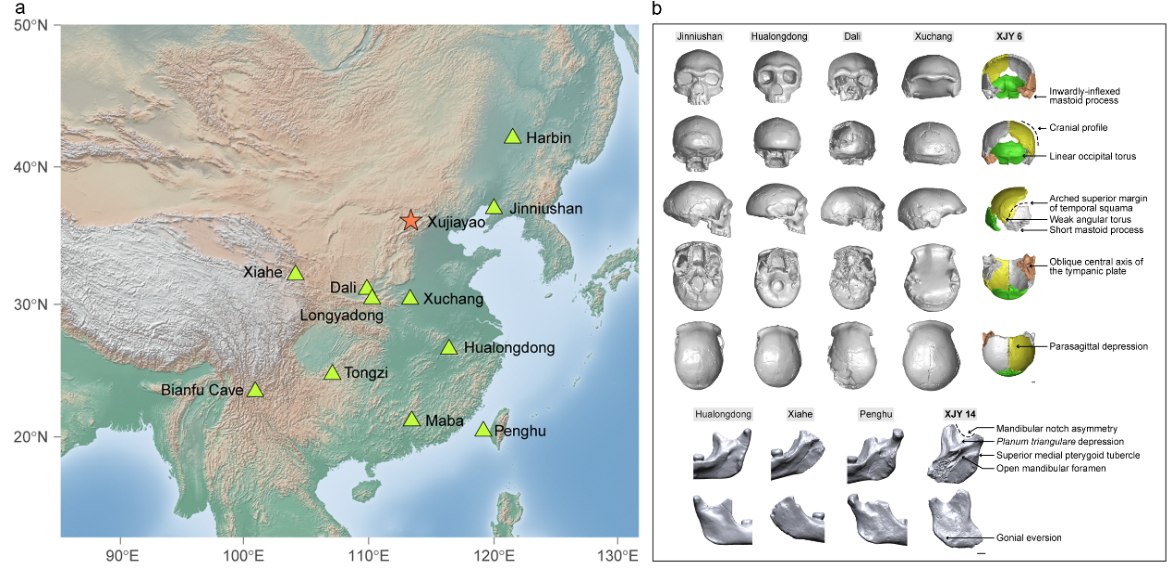
Fig. 1. The geographic distribution of Xujiayao and other East Asian Denisovans (a); The morphological comparison of Xujiayao fossils and comparative specimens (b).
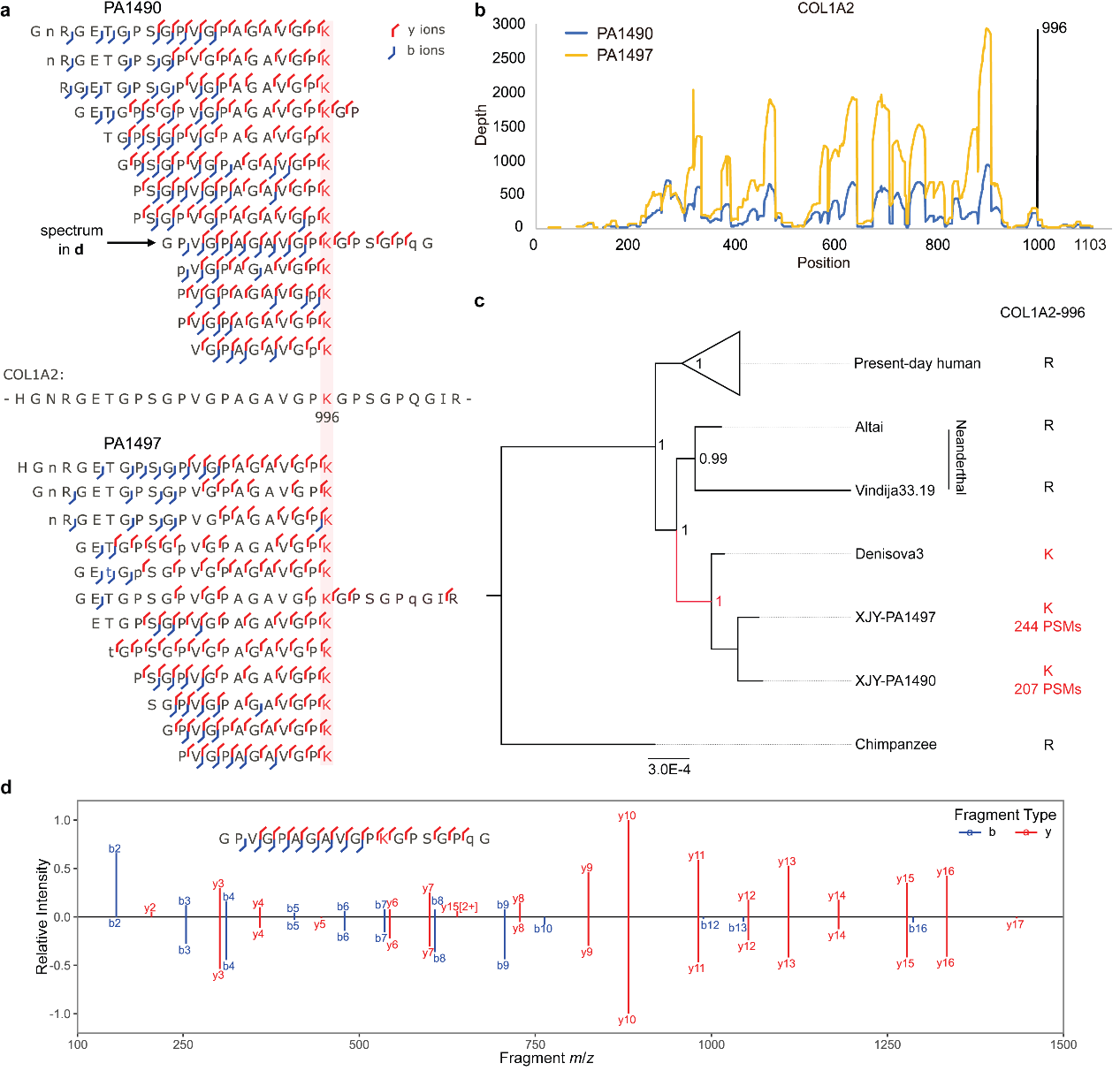
Fig. 2. Molecular evidence of Xujiayao samples belonging to Denisovan.