Home>RESEARCH>Research Progress

Institute of Vertebrate Paleontology and Paleoanthropology
Chinese Academy of Sciences
Chinese Academy of Sciences

Home>RESEARCH>Research Progress
People first arrived in the Palau archipelago around 3,200 years ago, according to archaeological findings, but prior to this study, no genome-wide ancient DNA data have been available. Now, a team of researchers led by Drs. Yue-Chen Liu, Joanne Eakin, Jolie Liston, Rosalind Hunter-Anderson, Ron Pinhasi, and David Reich has determined that the earliest inhabitants of Palau (and similarly, modern-day Palauans), have approximately 60% East Asian and 40% Papuan ancestry, providing strong evidence of genetic continuity for at least 2,800 years. The study: “Papuan admixture predated the settlement of Palau”, published this month in the journal Cell, reveals that the two lineages merged centuries before migration to Palau. “A natural expectation was that the admixture of Papuan ancestry in Palauan ancestors occurred around the same time as in other remote Oceanians [about 2,500-2,000 years ago] so our new results of earlier Papuan mixture were surprising.” The study also disconfirms previous models based on historical linguistics.
The researchers analyzed 37 skeletal specimens from four archaeological sites in Palau: Ngermereues Ridge burial cave, Ucheliungs Rock Island burial cave, Omedokl Rock Island burial cave, and the Ngkeklau area in northeastern Babeldaob, and retrieved whole genome data for 21 individuals. Seventeen radiocarbon dates were generated from 13 individuals, along with measurements of carbon and nitrogen isotopes. Direct dates from 11 unique samples included two that were close to the time of settlement of Palau at 2,924-2,710 years calBP (before present) and 2,776-2,495 years calBP.
The scientists compared data with previously reported information from neighboring regions and found that the East Asian ancestry is more closely related to eastern Indonesians from Aru Namara and Tanjung Pinang on Morotai Island, Northern Maluku, than to early lineages from the southwest Pacific and the Mariana Islands of Micronesia. The data also indicated that all the ancient individuals from Palau had significant Papuan admixture. ‘Papuan’ refers to those with primary ancestry from New Guinea, the Bismarck Archipelago, and the Solomon Islands, and in this case, the Papuan admixture is more closely related to people of the New Guinea Highlands. The ancestors of the first people of Palau were already mixing with people of Papuan ancestry close to a millennium before significant movement into remote Oceania.
Researchers included scientists from IVPP-CAS, Harvard, Vienna, the University of Georgia, the University of New Mexico, the Palau Bureau of Cultural and Historic Preservation, and independent researchers.
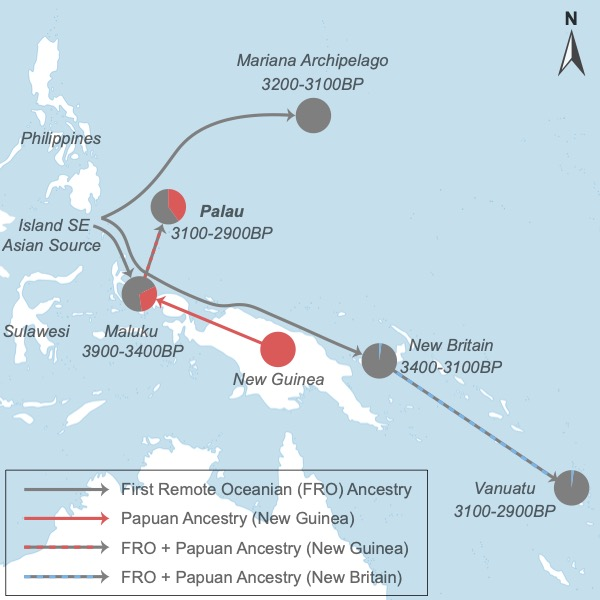
Palauan ancestry from East Asian and Papuan admixture.

Rock Islands of Palau. Photo: Patrick Colin, Coral Reef Research Foundation, Palau