Home>RESEARCH>Research Progress

Institute of Vertebrate Paleontology and Paleoanthropology
Chinese Academy of Sciences
Chinese Academy of Sciences

Home>RESEARCH>Research Progress
An international study led by the Institute of Vertebrate Paleontology and Paleoanthropology (IVPP) of the Chinese Academy of Sciences, with the participation of the National Research Center on Human Evolution (CENIEH, Spain) and the Australian Research Center for Human Evolution (Griffith University, Australia), presents an integrated review of China’s fossil, archaeological, and genomic record spanning the last two million years.
The new study was published in Nature Ecology & Evolution on 24 February 2026.The study concludes that East Asia, far from being a peripheral setting in human evolutionary history, may have functioned as a dynamic epicenter of Homo lineages, harboring greater biological and cultural diversity than previously recognized. The article, authored by Shi-Xia Yang (IVPP), María Martinón-Torres (CENIEH), and Michael Petraglia (Griffith University), analyzes and integrates the major paleoanthropological and archaeological discoveries made in China over recent decades and explores their evolutionary implications. According to the authors, evolutionary dynamics outside Africa were more complex and geographically widespread than suggested by earlier simplified models.
These days, a series of major paleoanthropological discoveries in China have established the region as a "natural laboratory" for exploring human evolution, continuously reshaping the global landscape of human evolution research. The rapid advancement of molecular biology is progressively becoming a core approach for defining hominin lineages, yet basic morphological research remains indispensable for clarifying the evolutionary weight we attribute to specific mutations and variants. Future breakthroughs in related research will rely more heavily on the deep integration of molecular and anatomical perspectives. Furthermore, the current insufficient integration between biological evidence and behavioral evidence continues to constrain the progression of Chinese human evolution research to a deeper level.
What is particularly exciting is that, with the continuous accumulation of fossil materials, archaeological remains, chronological data, and paleoenvironmental evidence, a series of long-standing evolutionary questions are poised to encounter new opportunities for resolution. For instance: How did different hominin species or groups in East Asia adapt to dynamic habitat changes over the past two million years? Did their adaptive innovations correspond with ecological environmental shifts? Was there cultural sharing among Middle Pleistocene hominin populations, and what survival advantages did such sharing confer? In-depth exploration of these questions will provide critical "pieces" for solving the puzzle of human evolution.
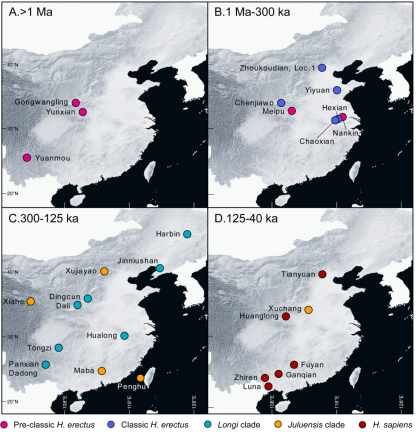
Figure 1 Geographic distribution of the Homo fossil record in China over the past 2 million years
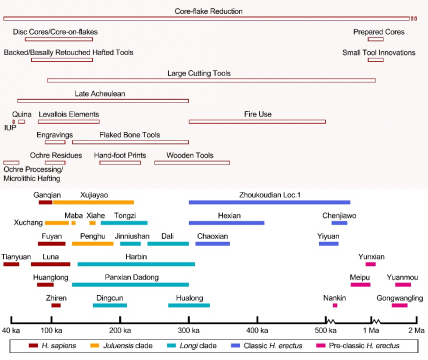
Figure 2 Key hominin fossils and behaviours in China over the past 2 million years.
Link for the paper :https://www.nature.com/articles/s41559-026-02983-w