Institute of Vertebrate Paleontology and Paleoanthropology
Chinese Academy of Sciences
Institute of Vertebrate Paleontology and Paleoanthropology
Chinese Academy of Sciences
Research Progress
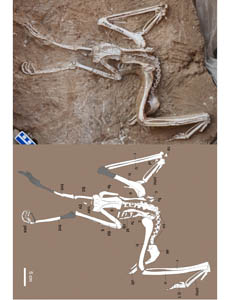
  • Fish-Eating Enantiornithine Bird Provides Evidence of Modern Avian Digestive Features
    In paper published May 9 in the journal of Current Biology (26), Drs. WANG Min, ZHOU Zhonghe and Corwin Sullivan, Institute of Vertebrate Paleontology and Paleoanthropology (IVPP ), Chinese Academy of Sciences, reported a new piscivorous enantiornithine from the Early Cretaceous Jehol Biota of China. This specimen preserves a gastric pellet that includes fish bones, and is the oldest birds’ pellet dating back 120 million years ago.This finding provides evidence of modern avian digestive features in the Early Cretaceous enantiornithine birds.
    READ MORE >> May 06, 2016
  • Drawing the Genetic History of Ice Age Eurasian Populations
    A research team led by Prof. FU Qiaomei from the Institute of Vertebrate Paleontology and Paleoanthropology at the Chinese Academy of Sciences (IVPP of CAS) and other international scientists (Profs. David Reich, Svante P??bo and Johannes Krause) has analyzed genome-wide data from 51 Eurasians from ~45,000-7,000 years ago and provided the first vivid look at the genetic history of modern humans in Eurasia before the start of agriculture ~8,500 years ago. Their findings were published as an ARTICLE in Nature with the title “The genetic history of Ice Age Europe” on May 2.
    READ MORE >> May 03, 2016
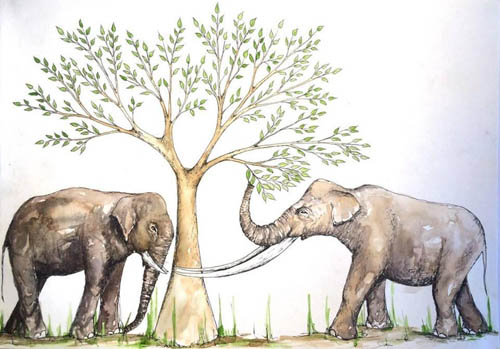
  • Konobelodon was discovered firstly in China by the Institute of Vertebrate Paleontology and Paleoanthropology
    READ MORE >> Apr 20, 2016
  • Female preference promotes asynchronous sex evolution in proboscideans
    READ MORE >> Apr 05, 2016
  • New Type of Dinosaur Eggs Found from Early Cretaceous of Gansu Province, China
    In a paper published in the latest issue of Vertebrata PalAsiatica, paleontologists described a new type of dinosaur eggs from the Lower Cretaceous Hekou Group in the Lanzhou-Minhe Basin, northwestern China, and established a new oogenus and a new oospecies, within a new oofamily. This finding has important implications for understanding the diversity and the geological and geographical distribution of Early Cretaceous dinosaur eggs in China, as well as the evolution of dinosaur eggshell structure.
    READ MORE >> Apr 05, 2016
  • New Amphicyonid Material Found from the Early Miocene of Central Nei Mongol
    Temnocyonine and haplocyonine amphicyonids (beardogs) are such an example that have been discovered both in Europend and North America, but remained absent in Asia. A newly discovered amphicyonid from the Early Miocene of central Nei Mongol, reported in the latest issue of Vertebrata PalAsiatica, filled in the long-expected Asian gap, offering new material for studies of Holarctic zoogeography.
    READ MORE >> Mar 30, 2016