Institute of Vertebrate Paleontology and Paleoanthropology
Chinese Academy of Sciences
Institute of Vertebrate Paleontology and Paleoanthropology
Chinese Academy of Sciences
Research Progress
  • Cretaceous Bird Clarifies Early Trophic Evolution in the Ornithuromorpha
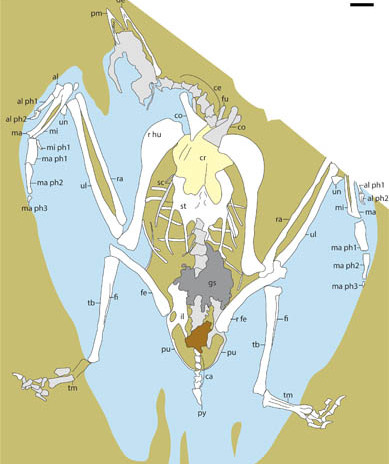
    In a new study published Jan 30 in Proceedings of the Royal Society B, a team of researchers from the Institute of Vertebrate Paleontology and Paleoanthropology (IVPP), Chinese Academy of Sciences, and Lingyi University in Shandong, has shown that a previously described specimen of Hongshanornis longicresta from the Shandong Tianyu Museum of Nature is actually a new species, which they name Eogranivora edentulata. This new species is a basal member of the Ornithuromorpha, helping to clarify trophic driven patterns of tooth loss within the Ornithuromorpha, and its apparent loss of the hallux may represent the first such occurrence in a Mesozoic bird and suggests a highly terrestrial lifestyle.
    READ MORE >> Jan 31, 2018
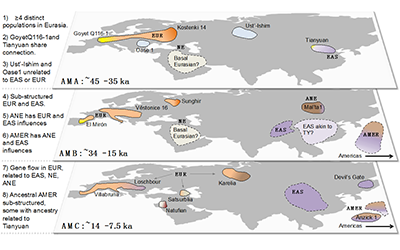
  • How ancient genomics unveils the prehistory of humans
    READ MORE >> Jan 29, 2018
  • Exceptionally Preserved Eggs and Embryos Reveal the Life History of a Pterosaur
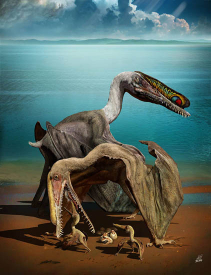
    Dr. WANG Xiaolin, Institute of Vertebrate Paleontology and Paleoanthropology (IVPP) of the Chinese Academy of Sciences (CAS), and his team reported on hundreds of three-dimensional (3D) pterosaur eggs of the species Hamipterus tianshanensis from a Lower Cretaceous site in the Turpan-Hami Basin, 16 of which contain embryonic remains, allowing for an unexpected look at the embryology and reproductive strategy of these flying reptiles. Their study was published online 30 November in Science.
    READ MORE >> Dec 01, 2017
  • Genome-wide Data from a 40,000-year-old Man in China Reveals Complicated Genetic History of Asia
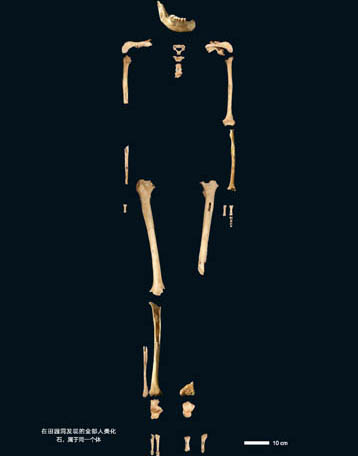
    The biological makeup of humans in East Asia is shaping up to be a very complex story, with greater diversity and more distant contacts than previously known, according to a new study in Current Biology analyzing the genome of a man that died in the Tianyuan Cave near Beijing, China 40,000 years ago. His bones had enough DNA molecules left that a team led by Professor FU Qiaomei, at the Molecular Paleontology Lab at the Chinese Academy of Sciences Institute of Vertebrate Paleontology and Paleoanthropology (IVPP), could use advanced ancient DNA sequencing techniques to retrieve DNA from him that spans the human genome. Though several ancient humans have been sequenced in Europe and Siberia, few have been sequenced from East Asia, particularly China, where the archaeological record shows a rich history for early modern humans. This new study on the Tianyuan man marks the earliest ancient DNA from East Asia, and the first ancient genome-wide data from China.

    READ MORE >> Oct 13, 2017
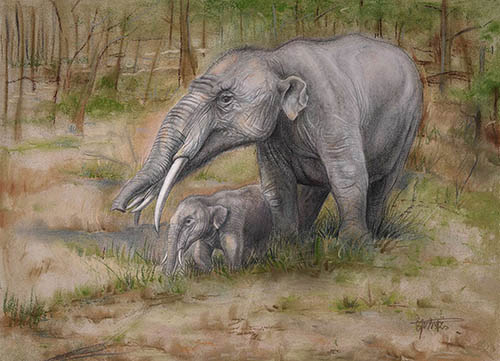
  • Research on Gomphotherium
    READ MORE >> Aug 15, 2017
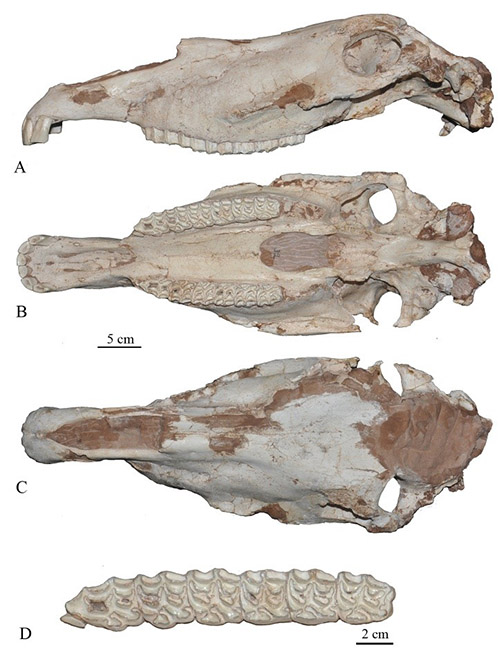
  • New progress of research on fossil Equus
    READ MORE >> Aug 07, 2017